
COLUMN: Carillon Flashback April 28, 1993 – Big birds enjoy Manitoba winter at Dawson Creek Ostrich Ranch
Advertisement
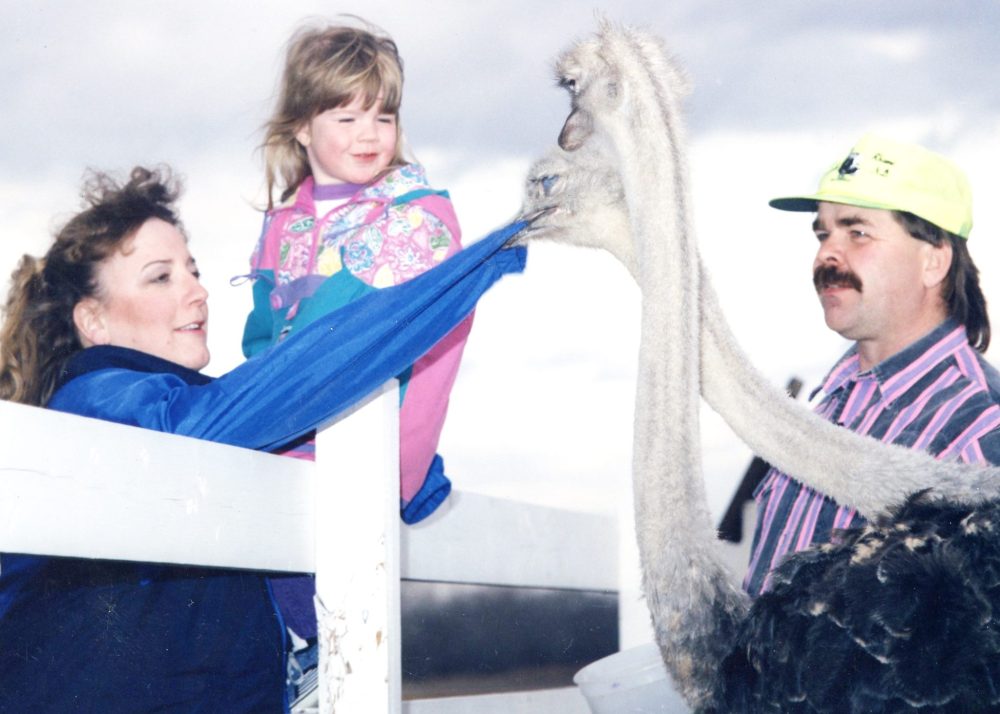
Three-year-old Carly Penner does not have to tune in to Sesame Street to catch a glimpse of Big Bird. She can watch her father’s favourite video, or better yet, go out in the backyard and chat with the real thing.
Delbert Penner’s Dawson Creek Ostrich Ranch, near Giroux, has been growing by leaps and bounds since four three-month-old chicks arrived from Oklahoma, three years ago. The herd (flock if you prefer) is now at 14 birds and four adult females are expected to start laying fertile eggs any day now.
In addition to two breeding trios, Penner’s 1993 herd includes one two-year-old male and seven yearlings. The yearlings are expected to be sold this summer, in spite of the steep asking price of $22,000 a pair.
The interest in the birds is phenomenal, Penner says, and hardly a day goes by that he doesn’t get a call from Quebec, Alberta or British Columbia. There is just as much interest beyond the boundaries of North America.
“The government of China has just spent $1.4 million on eight breeding pairs.”
Good news for breeders, like Penner, is that Australia has a special interest in buying Canadian birds. Because of the harsh climate, a hardier breed are produced here.
Dawson Creek ostriches have adapted well to Manitoba’s winters and until the temperature dips to 25 below, they are outside every day, Penner said.
The price is going up every day and some of the friends who were scoffing at Penner, now are beginning to show interest themselves.
Penner says the first birds they bought cost $5,500 a pair in American currency. Today, those same chicks are running at $8,500 US.
A pair of Dawson Creek yearlings, which sold at $14,000, were sold again by an Interlake dairy farmer for $45,000 as two-year-olds.
“The return on a 90-cent-a-day feed budget is worth the effort.”
And there is no shortage of investors lining up to get in on the ground floor of what is proving to be a very lucrative business. Organizers of a seminar during the recent Canadian Ostrich Association’s convention in Edmonton had to turn away 150 people before the morning’s registrations were in.
Penner remembers 1,200 people jamming into a room reported to hold 750, to watch a video on ostrich farming at a national convention in Las Vegas, a while ago.
He is quick to point out there is a very good reason for the popularity of this large, curious, and sometimes overly friendly bird. A trip into their enclosure is an adventure, as the ostrich pecks at glasses, belt buckles and any other shiny object that strays within range.
Penner describes the bird as an environmentally friendly, money machine. A 14-month-old ostrich yields over 70 pounds of meat and enough leather for six pairs of cowboy boots.
Ostrich meat is sold in Texas for $10 a pound and boots are a pricey $850 a pair. While Penner has a pair in his closet, he doesn’t advertise the fact too much.
Penner, who used to own quarter horses, has traded that hobby in for a new one that he expects will make him a little more money.
Until now, Penner has been buying chicks, selling yearlings, and pouring the profits back into chicks. A brand new $9,000 incubator from Florida may soon change all that.
It won’t be long before Dawson Creek Ostrich Ranch becomes local competition for a North Dakota supplier, who sells 120 chicks a year.
Penner said his brother Murray agreed to become a partner in the venture, but a second brother, who is also involved in the family’s hog, beef and grain operation, declined the offer.
“With hogs, beef and grain, we are already in everything that loses money.”